

Daily Devotional
Saturday, May 21, 2016 (NS), May 8, 2016 (OS)
No Fasting.
Saturday of the Third Week
The commemoration of the holy and all-praised Apostle and Evangelist John the Theologian, and our venerable Father Arsensios the Great.
Scripture Readings
Paschalion — Movable Calendar
Saturday of the Third Week
Epistle
The Reading is from the Acts of the Apostles [§ 22]. In those days:
9 19Saul was certain days with the disciples in Damascus, 20and straightway he began proclaiming Jesus in the synagogues, that this One is the Son of God. 21And all those who heard were amazed, and were saying, “This is the one, is it not, who ravaged those who called upon this name in Jerusalem, and had come here for this, that he might bring them bound to the chief priests?” 22But Saul was empowered the more, and was confounding the Jews who dwelt in Damascus, teaching that this is the Christ. 23And when many days were fulfilled, the Jews took counsel together to kill him; 24but their plot was made known to Saul. And they were watching the gates closely, both day and night, that they might kill him. 25But the disciples took him by night and let him down through the wall, lowering him in a basket. 26And after Saul came up to Jerusalem, he was attempting to join himself to the disciples; but they were all fearing him, not believing that he was a disciple. 27But Barnabas took him and brought him to the apostles. And he set out in detail to them how he saw the Lord in the way, and that He spoke to him, and how he spoke boldly at Damascus in the name of Jesus. 28And he was with them in Jerusalem, going in and going out, 29and speaking boldly in the name of the Lord Jesus. And he was both talking and disputing with the Hellenists, but they attempted to put their hands to kill him. 30But after the brethren came to know this, they brought him down to Cæsarea, and sent him forth to Tarsus.
31Then indeed were the churches throughout all of Judæa and Galilee and Samaria having peace, being built up and proceeding in the fear of the Lord, and in the comfort of the Holy Spirit they were being multiplied.
Gospel
The Reading is from the Holy Gospel according to Saint John [§ 52]. The Lord said to His disciples:
15 17“These things I command you, that ye be loving one another.
18“If the world hate you, ye know that it hath hated Me before it hath hated you. 19“If ye were of the world, the world would love its own; but because ye are not of the world—but I chose you for Myself out of the world—therefore the world hateth you. 20“Keep on remembering the word which I said to you, ‘A slave is not greater than his lord.’ If they persecuted Me, they will also persecute you; if they kept My word, they will keep yours also. 21“But all these things they will do to you for My name’s sake, because they know not the One Who sent Me. 22“If I had not come and spoken to them, they would not have sin, but now they have no pretext for their sin. 23“The one who hateth Me hateth My Father also. 24“If I did not do the works among them which no other one hath done, they would not have sin; but now they have both seen and hated both Me and My Father. 25“But this cometh to pass that the word might be fulfilled which hath been written in their law: ‘They hated Me without a cause [cf. Ps. 34(35):22, 68(69):5(4)].’ 26“But whenever the Paraclete should come, Whom I shall send to you from the Father, the Spirit of the truth Who proceedeth from the Father, that One shall bear witness concerning Me. 27“And ye also are bearing witness, because ye have been with Me from the beginning.
16 1“These things I have spoken to you, in order that ye should not be made to stumble. 2“They shall put you out of the synagogues; yea moreover, there cometh an hour that everyone who killeth you should think that he offereth God a service.”
Menaion — Fixed Calendar
The commemoration of the holy and all-praised Apostle and Evangelist John the Theologian, and our venerable Father Arsensios the Great.
Epistle
The Reading is from the First General Epistle of Saint John [§ 68 B].
1 1That which was from the beginning, that which we have heard, that which we have seen with our eyes, that which we beheld, and our hands touched, concerning the Logos of the Life— 2and the Life was manifested, and we have seen, and bear witness, and relate to you the Life, the Eternal One, which was with the Father and was manifested to us— 3that which we have seen and heard we relate to you, in order that ye also may have communion with us; and our communion also is with the Father and with His Son, Jesus Christ. 4And these things we write to you in order that our joy may be made full.
5And this is the message which we have heard from Him and we announce to you, that God is light and in Him is no darkness at all. 6If we should say that we have communion with Him, and walk in the darkness, we lie and do not practise the truth; 7but if we walk in the light, as He is in the light, we have communion with one another, and the blood of Jesus Christ His Son cleanseth us from all sin.
Gospel
For the Apostle:
The Reading is from the Holy Gospel according to Saint John [§§ 61, mid 67]. At that time:
19 25There had stood by the Cross of Jesus His Mother, and His Mother’s sister, Mary the wife of Cleopas, and Mary Magdalene. 26Then Jesus, having seen His Mother and the disciple whom He loved standing by, saith to His Mother, “Woman, behold thy son.” 27Then He saith to the disciple, “Behold, thy Mother.” And from that hour the disciple took her into his own home....
21 24This is the disciple who beareth testimony concerning these things, and wrote these things; and we know that his testimony is true. 25And there are also many other things, which if as much as Jesus did may be written one by one, I suppose even the world itself could not contain the books that would be written. Amen.
For the venerable Father:
The Reading is from the Holy Gospel according to Saint Matthew [§ 43]. The Lord said to His disciples:
11 27“All things were delivered to Me by My Father. And no one doth fully know the Son, except the Father; nor doth anyone fully know the Father, except the Son, and he to whomsoever the Son is willing to reveal Him. 28“Come to Me, all ye who labor and are burdened, and I will give you rest. 29“Take up My yoke upon you and learn from Me, for I am meek and humble in heart; and ye shall find rest to your souls. 30“For My yoke is good and My burden is light.”
Lives of the Saints (Prologue)
May 21st – Civil Calendar
May 8th – Church Calendar
1. The Holy Apostle and Evangelist John.
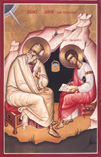 The main commemoration of this great apostle
and evangelist is on September 26th, but on May 8th is commemorated a wonderful revelation
about his grave. When St. John was more than a hundred years old, he took seven of his
disciples, went outside the city of Ephesus and told the disciples to dig a grave in the
form of a cross. Then the elder went down alive into the grave, gave up his soul to the
Lord, and was buried. When the faithful later opened John’s grave, they did not find
the body in it. And on May 8th each year a dust arose from the grave, from which those
suffering from many diseases were healed. |
2. Our Holy Father Arsenius the Great.
This famous saint was born of a patrician family in Rome, and was well-educated both in secular learning and philosophy and in spiritual wisdom. Abandoning all secular studies, he gave himself to the service of the Church and was deacon in a large church in Rome. Unmarried, retiring, silent and prayerful, Arsenius thought that he would spend his whole life in that way. But, by the providence of God, his life was directed in a different way. The Emperor Theodosios summoned him to bring up and educate his two sons, Arkadios and Honorios, and made him a senator, surrounding him with wealth, honor and luxury. But this was a greater burden than pleasure to the heart of Arsenius. It happened at one time that Arkadios was at fault, and Arsenius punished him for it. The insulted Arkadios thought up a harsh revenge on his teacher, and when Arsenius discovered this, he dressed himself in simple clothing, went to the coast, got into a boat and sailed off to Egypt. When he arrived at the famous Sketis, he became a disciple of John Kolovos and gave himself to asceticism. He considered himself as one dead, and when he was informed that a rich kinsman had died and left him all his goods, he replied: ‘I died before he did. How, then, can I be his heir?’ He retired to a cell in the desert as into a grave, and there he spent his days weaving baskets from palm leaves and his nights in prayer. He fled from men and from every conversation with men. Only on feast days did he leave his cell and come to the church for Communion. In order not to become idle, he often put this question to himself: ‘Arsenius, why did you come into the desert?’ He spent thirty-five years as a hermit, and all that time he was an example to the monks and the glory of monasticism. In all, he lived a hundred years and departed this life peacefully in 448, after long labors and trials voluntarily taken on himself. He went to the kingdom of Christ the Lord, Whom he had loved with all his heart and soul.
3. St. Emilia.
She was the mother of St. Basil the Great. In her youth, she desired to remain a life-long virgin, but was forced to marry. She bore nine children, and so endowed each of them with a Christian spirit that five of them became Christian saints: Basil the Great, Gregory of Nyssa, Peter of Sebaste, Makrina and Theosevia. She founded a monastery in her old age, where she lived with her daughter Makrina, and where she entered into rest in the Lord on May 8th, 375.
4. Our Holy Father Arsenius the Lover of Labor.
A monk of Kiev, he never gave himself any rest, but worked without pause. He ate only once a day, at sunset. He lived in asceticism and died in the 14th century.
FOR CONSIDERATION
A monk complained to St. Arsenius that, while reading the holy Scriptures, he felt neither the power of the words he read nor any sweetness in his heart. To this the great saint replied: ‘My child, just read! I have heard that snake-charmers, when they cast a spell on the snakes, pronounce words that they themselves do not understand; but the snakes, hearing the words spoken, feel their power and are tamed. So with us, when we constantly keep the words of holy Scripture on our lips; even if we cannot feel their power, the evil spirits, hearing these words, flee in terror, for they cannot abide the word of the Holy Spirit. My child, just read. The Holy Spirit, Who wrote the divine words through those He inspired, will hear and understand, and will hasten to your aid; and the demons will hear and understand, and will flee from you. That is: He Whom you summon to your aid will understand, and he whom you want to drive from you will understand, and both goals will be reached.’
Daily Scripture Readings taken from The Orthodox New Testament, translated and published by Holy Apostles Convent, Buena Vista, Colorado, copyright © 2000, used with permission, all rights reserved.
Daily Prologue Readings taken from The Prologue of Ochrid, by Bishop Nikolai Velimirovic, translated by Mother Maria, published by Lazarica Press, Birmingham, England, copyright © 1985, all rights reserved. Edited by Dormition Skete.