

Daily Devotional
Monday, May 16, 2016 (NS), May 3, 2016 (OS)
No Fasting.
Monday of the Third Week
The commemoration of the holy Martyrs Timothy the Reader and Mavra of Antinoe in Egypt, and our venerable Father Theodosios, Abbot of the Monastery of the Caves, initiator of the cenobitic monastic life in Russia.
Scripture Readings
Paschalion — Movable Calendar
Monday of the Third Week
Epistle
The Reading is from the Acts of the Apostles [§ 17]. In those days:
6 8Stephen, full of faith and of power, was doing great wonders and signs among the people. 9But there rose up some of those from the synagogue which is called that of the Libertines, and Cyrenians, and Alexandrians, and of those from Cilicia and Asia, disputing with Stephen. 10And they were not able to stand against the wisdom and the spirit by which he was speaking. 11Then they suborned men, who said, “We have heard him speaking blasphemous words against Moses and God.” 12And they stirred up the people, and the elders, and the scribes. And having set upon him, they seized him, and brought him to the sanhedrin. 13And they set up false witnesses, saying, “This man ceaseth not speaking blasphemous words against this holy place and the law; 14“for we have heard him saying that this Jesus the Nazaræan shall destroy this place and shall change the customs which Moses delivered to us.” 15And having looked intently upon him, all those sitting in the sanhedrin saw his face as though it were a face of an angel.
7 1Then the high priest said, “Are then these things so?” 2And he began saying, “Men, brethren, and fathers, hearken: The God of glory appeared to our father Abraham when he was in Mesopotamia, before he dwelt in Haran, 3“and said to him, ‘Get thee out from thy land and from thy kindred, and come here into a land which I shall show thee [cf. Gen. 12:1].’ 4“Then after he went out from the land of the Chaldæans, he dwelt in Haran. And from that place, after his father died, He removed him into this land in which ye now dwell. 5“And He did not give him an inheritance in it, not even the breadth of a footstep. And yet He promised to give it to him for a possession, and his seed after him, though he had no child.... 47“But Solomon built Him a house. 48“But the Most High dwelleth not in temples made by hand, even as the prophet saith, 49“‘The heaven is a throne to Me, and the earth a footstool of My feet; what manner of house will ye build Me,’ saith the Lord, ‘or what is the place of My rest [cf. Is. 66:1]? 50“‘My hand did make all these things, did it not [cf. Is. 66:2]?’ 51“O stiff-necked and uncircumcised in the heart and in the ears, ye always fall in a direction contrary to the Holy Spirit; as your fathers did, also do ye. 52“Which of the prophets have your fathers not persecuted? And they slew those who announced beforehand about the coming of the righteous One, of Whom now ye have become betrayers and murderers, 53“ye who received the law by the disposition of angels, and guarded it not.” 54And when they heard these things their hearts were sawn asunder, and they were gnashing their teeth at him. 55But he, being full of the Holy Spirit, gazed intently into the heaven, and saw the glory of God, and Jesus standing on the right of God; 56and he said, “Behold, I see the heavens having been opened and the Son of Man standing on the right of God.” 57And they cried out with a loud voice, and they held their ears together, and rushed upon him with one accord. 58And they cast him outside of the city and began stoning him. And the witnesses themselves laid aside their garments at the feet of a young man who was called Saul. 59And they kept on stoning Stephen as he called upon the Lord and said, “Lord Jesus, receive my spirit.” 60And having knelt down, he cried with a loud voice, “Lord, do not make this sin stand against them.” And having said this, he fell asleep.
Gospel
The Reading is from the Holy Gospel according to Saint John [§ 13]. At that time:
4 46There was a certain king’s officer whose son was sick in Capernaum. 47After this one heard that Jesus had come out of Judæa into Galilee, he went off to Him, and was entreating Him that He would come down and heal His son, for he was about to die. 48Then Jesus said to him, “Unless ye see signs and wonders, in no wise will ye believe.” 49The king’s officer saith to Him, “Sir, come down before my little child die.” 50Jesus saith to him, “Go thy way; thy son liveth.” And the man believed the word which Jesus said to him, and started on his way. 51But already, as he was going down, his slaves met him and brought tidings, saying, “Thy child liveth.” 52Then he learned from them the hour in which he got better. And they said to him, “Yesterday at the seventh hour the fever left him.” 53So the father knew that it was at that hour in which Jesus said to him, “Thy son liveth.” And he himself believed, and his whole house. 54Again, this second sign Jesus did, having come out of Judæa into Galilee.
Menaion — Fixed Calendar
The commemoration of the holy Martyrs Timothy the Reader and Mavra of Antinoe in Egypt, and our venerable Father Theodosios, Abbot of the Monastery of the Caves, initiator of the cenobitic monastic life in Russia.
Epistle
For the venerable Father:
The Reading is from the Epistle of Saint Paul to the Hebrews [§ 334]. Brethren:
13 7Be remembering those who lead you, who spoke to you the word of God, whose faith keep on imitating, observing attentively the end of their conduct: 8Jesus Christ, the same yesterday and today and to the ages. 9Cease being carried about by various and strange teachings. For it is good for the heart to be confirmed by grace, not by foods, in which those walking therein were not profited. 10We have an altar from which those serving the tabernacle have no authority to eat; 11for the bodies of those animals, “whose blood is being brought into the holies for sins” by the high priest, “are being burned outside of the encampment [cf. Lev. 16:27].” 12Wherefore Jesus also, that He might sanctify the people by His own blood, suffered outside of the gate. 13Let us be going forth therefore to Him outside of the encampment, bearing His reproach; 14for we have no abiding city here, but we seek the coming one. 15Through Him, then, let us be offering up a “sacrifice of praise [Lev. 7:2(12)]” continually to God, that is, “the fruit of the lips [cf. Hos. 14:3(2); Is. 57:19],” giving thanks to His name. 16But cease being forgetful of doing good and of contributing; for God is well pleased with such sacrifices.
Gospel
The Reading is from the Holy Gospel according to Saint Matthew [§ 43]. The Lord said to His disciples:
11 27“All things were delivered to Me by My Father. And no one doth fully know the Son, except the Father; nor doth anyone fully know the Father, except the Son, and he to whomsoever the Son is willing to reveal Him. 28“Come to Me, all ye who labor and are burdened, and I will give you rest. 29“Take up My yoke upon you and learn from Me, for I am meek and humble in heart; and ye shall find rest to your souls. 30“For My yoke is good and My burden is light.”
Lives of the Saints (Prologue)
May 16th – Civil Calendar
May 3rd – Church Calendar
1. The Holy Martyrs Timothy and Mavra.*
Strange was the destiny of these wonderful martyrs, husband and newly-wedded wife. Twenty days after their wedding, they were taken for trial for their Christian Faith before Arrianos, the pagan governor of the Thebaid, in the time of the Emperor Diocletian. Timothy was a reader in the church where he lived. ‘Who are you?’ the governor asked him. Timothy replied: ‘I am a Christian and a reader in the Church of God.’ The governor said to him further: ‘You see, don’t you, the instruments prepared for torture?’ Timothy replied: ‘But you don’t see the angels of God, which are strengthening me.’ Then the governor commanded that he be pierced through the ears with iron rods, so that the pupils of his eyes leapt out with the pain. They then suddenly hanged him by the feet and stuffed his mouth with wood. Mavra was at first afraid of torture, but when her husband gave her courage, she also confessed her steadfast faith before the governor. He commanded that, first, her hair be torn out, then all her fingers cut off. After many other tortures, to which they would quickly have succumbed had they not been strengthened by the grace of God, they were both crucified, one in sight of the other. And thus, hanging on their crosses, they remained alive for nine full days, counseling each other and encouraging each other in endurance. On the tenth day they gave their spirits into God’s hands, the God for Whom they had suffered crucifixion, and thus became worthy of His kingdom. They suffered with honor for Christ in 286.
* Author’s note: ‘Mavra’ means ‘black,’ from which it comes that in Macedonia the day of these saints is known as ‘Black Day’. On the island of Zakynthos there is a church of Saints Timothy and Mavra, in which many miraculous healings have taken place.
2. Our Holy Father Theodosius (Feodosy) of the Kiev Caves.
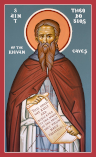 From his earliest youth, he fled from laughter and merriment and gave himself to pondering on
God and prayer. Because of this, he was often beaten by his mother, and especially when she saw
one day an iron belt around his naked body, from which his shirt was stained with blood. Reading
one day in the Gospel the words of the Lord: ‘He who loves father or mother more than Me,
is not worthy of Me,’ he left his parents’ home and fled to Kiev, to the cave of our
holy father Anthony. Anthony received him and quickly made him a monk. When his mother found him,
and called him to return home, he spoke with her and she then became a nun in a women’s
monastery. By his asceticism, his meekness and his goodness, Theodosius quickly outstripped all
the other monks and became very dear to Anthony, who made him abbot of the monastery. In his
time, the number of brethren in the monastery grew very rapidly, churches and cells were built,
and the Rule of the Studion was introduced in its fullness. God endowed Theodosius with great
grace in response to his virginal purity, labors in prayer and love for his neighbor, and so this
man of God had great power over unclean spirits and healed sicknesses and had insight into the
destinies of men. With St. Anthony, St. Theodosius is regarded as the restorer and organizer of
Russian monasticism. He entered peacefully into rest in 1074, and his healing relics rest beside
those of St. Anthony.
FOR CONSIDERATION
Abba John Kolovos asked his monks: ‘Who or what sold Joseph?’ One of them answered: ‘His brethren.’ To this the elder said: ‘Not his brothers, but his humility.’ Joseph could have revealed that he was their brother, and thus oppose the sale. But he kept silent about that. By humility, then, was he sold, and this same humility later made him ruler of Egypt. We guard ourselves too carefully from the outward difficulties encountered in giving ourselves over to the will of God, and so we lose the good fruits that are reaped in difficult circumstances endured with humility. Abba Poemen spoke wisely thus: ‘We have set aside the light yoke; that is, self-instruction, and loaded ourselves with the heavy one; that is, self-righteousness.’ Christians accept every difficulty as payment for past or present sins, seeking the will of God with faith in all things, and looking to the end with hope.
Daily Scripture Readings taken from The Orthodox New Testament, translated and published by Holy Apostles Convent, Buena Vista, Colorado, copyright © 2000, used with permission, all rights reserved.
Daily Prologue Readings taken from The Prologue of Ochrid, by Bishop Nikolai Velimirovic, translated by Mother Maria, published by Lazarica Press, Birmingham, England, copyright © 1985, all rights reserved. Edited by Dormition Skete.