

Daily Devotional
Tuesday, May 10, 2016 (NS), April 27, 2016 (OS)
No Fasting.
Tuesday of the Second Week
The commemoration of Hieromartyr Symeon, the kinsman of Jesus.
Scripture Readings
Paschalion — Movable Calendar
Tuesday of the Second Week
Epistle
The Reading is from the Acts of the Apostles [§ 10]. In those days:
4 1As the apostles spoke to the people, the priests and the captain of the temple-guard and the Sadducees came upon them, 2being troubled because they taught the people and proclaimed in Jesus the resurrection of the dead. 3And they laid hands on them and put them in custody until the morrow, for it was evening already. 4But many of those who heard the word believed; and the number of the men came to be about five thousand. 5And it came to pass on the morrow, that the rulers and elders and scribes were gathered together in Jerusalem, 6and also Annas the high priest and Caiaphas and John and Alexander, and as many as were of high priestly kindred. 7And having stood them in their midst, they began to inquire, “In what manner of power or in what manner of name did ye do this?” 8Then Peter, filled with the Holy Spirit, said to them, “Rulers of the people and elders of Israel: 9“If today we are being examined on account of a good deed done to an infirm man, regarding in what manner this man hath been healed, 10“be it known to you all, and to all the people of Israel, that in the name of Jesus Christ the Nazaræan, Whom ye crucified, Whom God raised from the dead, in Him this one standeth before you healthy.”
Gospel
The Reading is from the Holy Gospel according to Saint John [§ 10]. The Lord said to His disciples:
3 16“God so loved the world that He gave His only-begotten Son, that everyone who believeth in Him should not perish, but may have everlasting life. 17“For God did not send forth His Son into the world in order that He might condemn the world, but that the world might be saved through Him. 18“The one who believeth in Him is not judged; but the one who believeth not hath already been judged, because he hath not believed in the name of the only-begotten Son of God. 19“And this is the judgment, that the light hath come into the world, and men loved the darkness rather than the light, for their works were evil. 20“For everyone who practiseth bad things hateth the light and cometh not to the light, lest his works should be reproved; 21“but the one who doeth the truth cometh to the light, in order that his works might be made manifest, that they have been wrought in God.”
Menaion — Fixed Calendar
The commemoration of Hieromartyr Symeon, the kinsman of Jesus.
Epistle
The Reading is from the First Epistle of Saint Paul to the Corinthians [§ 131]. Brethren:
4 9I think that God showed forth us the apostles last, as condemned to death; for we became a spectacle to the world, both to angels and to men. 10We are fools for Christ’s sake, but ye are wise in Christ. We are weak, but ye are strong. Ye are held in honor, but we are dishonored. 11Until the present hour, we both hunger and thirst, and are naked, and are being buffeted, and never at rest. 12And we toil working with our own hands. Being reviled, we bless; being persecuted, we bear up; 13being evilly spoken of, we beseech. We became as the filth of the world, the off-scouring of all until now. 14I do not write these things shaming you, but admonishing you as my beloved children. 15For if ye have myriads of tutors in Christ, yet ye have not many fathers; for in Christ Jesus I begot you through the Gospel. 16Therefore, I beseech you, keep on becoming imitators of me.
Gospel
The Reading is from the Holy Gospel according to Saint Matthew [§ 56]. At that time:
13 54After Jesus came into His own country, He was teaching the crowds in their synagogue, insomuch that they were astonished and said, “From what place hath this One this wisdom and the works of power? 55“This is the carpenter’s Son, is it not? His Mother is called Mariam, is she not, and His brothers, Iakovos, and Joses, and Simon, and Judas? 56“And His sisters are all with us, are they not? From what place then hath this One all these things?” 57And they were offended in Him. But Jesus said to them, “A prophet is not without honor, except in his own country and in his own house.” 58And He did not do many works of power there because of their unbelief.
Lives of the Saints (Prologue)
May 10th – Civil Calendar
April 27th – Church Calendar
1. The Holy Apostle Simeon.
One of the Seventy, he was the son of Cleopas, and Cleopas was the brother of Joseph, the betrothed of the most holy Mother of God. Seeing the miracles of our Lord and Savior Jesus Christ, Simeon was converted and included among the Seventy apostles. With great zeal and courage, he preached the Gospel everywhere in Judea. When the wicked Jews killed Iakovos, the Lord’s brother and first bishop of the Church in Jerusalem, throwing him down from the top of the Temple and then stoning him to death, this Simeon, Joseph’s nephew, was installed as bishop in Jerusalem. He, as the second bishop of the holy city, governed the Church of God with wisdom and strength to a great age. He was more than a hundred years old when he suffered, and his sufferings came about as follows: in the time of the Emperor Trajan there was a double persecution begun in Palestine, against the descendants of David and against the Christians. The wicked people condemned Simeon on both counts. St. Simeon endured harsh torture and was finally crucified, as had been the Lord Whom he had faithfully served on earth.
2. Our Holy Father Stefan, Bishop of Vladimir.
A disciple of St. Theodosius of the Kiev Caves, Stefan was at one time abbot of the Monastery of the Caves and labored greatly in the regulation and organization of the monastic life and in the beautifying of the churches. But the enemy inflamed an evil monk against him, and he was not only removed from the abbacy but driven from the monastery. But God, Who does not leave the righteous long under the humiliation of the unrighteous, so guided the life of blessed Stefan that he was chosen as Bishop of Vladimir. As God’s hierarch, Stefan guided the Church to old age and departed this life in the Lord peacefully in 1094.
3. The Burning of the Relics of St. Sava, Archbishop of Serbia.
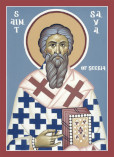 The body of St. Sava was buried at Mileševa.
In the time of the Turkish occupation, the Serbian people gathered together round the
relics of their saint, to seek support and healing. Fearing that a rebellion against the
Turks might be stirred up in that place, Sinan Pasha of Belgrade commanded that St.
Sava’s relics be brought to Belgrade and burned there at Vračar. This was done
on April 27th, 1594. But, with the burning of the saint’s relics, the wicked pasha
did not burn the saint, who remains alive before the throne of God in heaven and in the
hearts of his people on earth. |
4. Our Holy Father John the Confessor.
He was the abbot of the community ‘of the Pure’ (the Katharoi). This community was founded near Nicaea during the reign of Justin, in the 6th century. For his veneration of icons during a ban on such veneration, John suffered much at the hands of the Emperors Leo and Theophilus, and died under their persecution in about 832.
FOR CONSIDERATION
True faith will be persecuted in this world. The Savior Himself said this to His apostles clearly and publicly (Jn 16:32). And St. Apollinarius of Hierapolis, writing against the Montanist heretics, asserts: ‘Let them tell us, before God, who of all their prophets, beginning with Montanus and his wives, has been persecuted by the Jews and killed by the ungodly. No one. Who among them has been arrested for the name of Christ, and crucified? Again, no one. Have any of their women been flogged or stoned in the Jewish synagogues? No.’ This Orthodox saint means to say that it is true faith that will be persecuted in this world. Heresies are usually closer to the worldly and demonic spirit, and therefore the world and the demons do not persecute their own. To be constantly under persecution—with short breathing-spaces—is a distinguishing mark of the Faith and of the Orthodox Church. This persecution has existed throughout the whole of history, whether externally or internally; externally from unbelievers and internally from heretics.
Daily Scripture Readings taken from The Orthodox New Testament, translated and published by Holy Apostles Convent, Buena Vista, Colorado, copyright © 2000, used with permission, all rights reserved.
Daily Prologue Readings taken from The Prologue of Ochrid, by Bishop Nikolai Velimirovic, translated by Mother Maria, published by Lazarica Press, Birmingham, England, copyright © 1985, all rights reserved. Edited by Dormition Skete.