

Daily Devotional
Tuesday, May 3, 2016 (NS), April 20, 2016 (OS)
No Fasting.
Bright Week - No Fasting All Week
Tuesday of the Renewal Week
The commemoration of our venerable Father Theodore Trichinas ("the Hair-shirt Wearer"), hermit near Constantinople, and our venerable Father Anastasios of Sinai (commemorated on Gk. calendar on the 21st of April).
Scripture Readings
Paschalion — Movable Calendar
Tuesday of the Renewal Week
Epistle
The Reading is from the Acts of the Apostles [§ 4]. In those days:
2 14Peter, having taken his stand with the eleven, lifted up his voice and spoke out to them, “Men, Jews, and all those who inhabit Jerusalem, let this be known to you, and hearken to my words. 15“For these are not drunk, as ye suppose, for it is the third hour of the day. 16“But this is that which hath been spoken by the Prophet Joel, 17“‘And it shall be in the last days,’ saith God, ‘I will pour out of My Spirit upon all flesh; and your sons and your daughters shall prophesy, and your young men shall see visions, and your old men shall dream dreams [cf. Joel 2:28]; 18“‘and even upon My bondmen and upon My bondwomen in those days I will pour out of My Spirit [cf. Joel 2:29],’ and they shall prophesy. 19“‘And I will show wonders in the heaven above, and signs on the earth below, blood and fire and vapor of smoke [cf. Joel 2:30]. 20“‘The sun shall be turned into darkness, and the moon into blood, before that great and notable day of the Lord come [Joel 2:31]. 21“‘And it shall be that everyone, whosoever shall call upon the name of the Lord, shall be saved [Joel 2:32].’”
Gospel
The Reading is from the Holy Gospel according to Saint Luke [§ 113]. At that time:
24 12Peter arose and ran to the sepulcher; and having stooped to look, he saw the linen cloths lying alone, and departed to his home, wondering at that which had come to pass.
13And behold, two of them were going on the same day to a village, being sixty stadia from Jerusalem, which is named Emmaus. 14And they were conversing with one another about all these things which had taken place. 15And it came to pass, while they conversed and discussed, Jesus Himself drew near and was going together with them. 16But their eyes were held, so as not to recognize Him. 17And He said to them, “What words are these which ye exchange with one another, as ye walk and are sad in countenance?” 18And the one whose name was Cleopas answered and said to Him, “Art Thou sojourning alone as a stranger in Jerusalem, and hast not known the things which came to pass in it in these days?” 19And He said to them, “What kind of things?” And they said to Him, “The things concerning Jesus the Nazaræan, Who was a man, a prophet, mighty in deed and word before God and all the people, 20“how both the chief priests and our rulers delivered Him up to a judgment of death, and crucified Him. 21“But we were hoping that He was the One Who was about to redeem Israel; but, beside all these things, this passeth as the third day today since these things took place. 22“Yea, and certain women from among us astonished us, who were early at the sepulcher. 23“And not having found His body, they came, declaring also to have seen a vision of angels who say, ‘He is living.’ 24“And certain of those with us went away to the sepulcher, and found it thus, even as also the women said; but Him they did not see.” 25And He said to them, “O ye without understanding and slow in heart to believe in all things which the prophets spoke! 26“It was needful for the Christ to have suffered these things and to have entered into His glory, was it not?” 27And beginning from Moses and from all of the prophets, He went on interpreting to them in all the Scriptures the things concerning Himself. 28And they drew near to the village where they were going; and He was making as if to be going further. 29And they constrained Him, saying, “Stay with us, for it is toward evening, and the day hath waned.” And He went in to stay with them. 30And it came to pass, as He reclined at table with them, He took bread, and blessed it, and broke it, and was giving it to them. 31And their eyes were opened, and they recognized Him; and He disappeared from them. 32And they said to one another, “Our heart was burning in us as He was speaking to us in the way and as He was opening to us the Scriptures, was it not?” 33And they rose up the same hour and returned to Jerusalem, and found the eleven gathered together, and those with them, 34saying, “The Lord was raised indeed, and appeared to Simon.” 35And they began relating those things that occurred in the way, and how He was known to them in the breaking of the bread.
Menaion — Fixed Calendar
The commemoration of our venerable Father Theodore Trichinas ("the Hair-shirt Wearer"), hermit near Constantinople, and our venerable Father Anastasios of Sinai (commemorated on Gk. calendar on the 21st of April).
No readings given.
Lives of the Saints (Prologue)
Paschalion — Movable Calendar
Saints Raphael, Nicholas and Irene
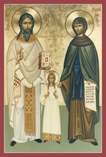 Archimandrite Raphael,
Abbot of the Theotokos Monastery, and Hierodeacon Nicholas, settled on Lesvos (Mytilene) after
the Fall of the City. In 1463, Muslims attacked on Great Friday. Archimandrite Raphael was pulled
and tugged by his hair and beard along the rock-strewn ground. He was struck with clubs, spears,
lances, and swords, while his hands were tied behind his back. He was stabbed all over and cast
down paralyzed. His tongue was severed, and he was then suspended upside down from a large walnut
tree, repeatedly beaten and whipped for 24 hours. He was cut down from the tree and stripped of
his clothing from the waist up. After being positioned on his knees, five savage Muslims took up
a saw and began cutting away his lower jaw. Nearly unconscious, he had his head placed on a
square icon, where they struck him thrice on his mouth, extracting his lower jaw, thus separating
his head from his body on Bright Tuesday, then the 9th of April.
Deacon Nicholas, bound to a smaller walnut tree, witnessed these
terrifying scenes. He, too, was stabbed, but he did not die immediately. It was only after his
terror-stricken tender heart had borne the startling sight of his wounds and the punishments of
the others, that he suffered cardiac arrest.
Twelve-year-old Irene was seized and had boiling water poured into
her mouth. One of her delicate hands was severed, the limb being tossed before the parents. The
stump of her arm was bleeding profusely, as they chopped away one of her little feet. The lass
was then pushed down into an earthen jar, where she was burned alive after being doused with
flammable liquids and torching her bodice. As she stood trapped in the flaming cask, she lifted
up her eyes heavenward and called upon Christ, commending her soul into the hands of the Lord.
In 1959 and in the early 1960’s miraculous visions of the
martyrs were granted to the islanders. The recovery of their relics has been the occasion of
countless miracles and pilgrimages.
Menaion — Fixed Calendar
May 3rd – Civil Calendar
April 20th – Church Calendar
1. Our Holy Father Theodore Trichinas.
He was a citizen of Constantinople, and the son of wealthy parents. He left parents, home and riches while still a young man and settled in a remote monastery in Thrace, where he undertook the most rigorous ascetic life. He slept on a stone so that he might have less sleep; he was always bareheaded and dressed in a hair-shirt, from which he was called ‘Trichinas’ or ‘hairy’. Because of his great and self-inflicted sufferings for the sake of his soul’s salvation, God granted him the gift of working miracles, both in his lifetime and after his death, and he died peacefully in about 400. Healing myrrh flowed from his relics.
2. Our Holy Father Anastasios of Mount Sinai.
He was abbot of Mount Sinai. He was for a long time a monk under the famous abbot, St. John of the Ladder, whom he succeeded on the latter’s death. He was also a great ascetic, and an eloquent narrator of the lives of the saints and the author of other instructive works. He fought an intensive battle against the heresy of the Akephalites, which was condemned by the Fourth Ecumenical Council at Chalcedon. He died in great old age in 685, and went to the Lord Whom he had served so faithfully.
3. Blessed Anastasios the Sinaite, Patriarch of Antioch.
He was chosen as Patriarch of Antioch in the reign of the Emperor Justinian while still a monk on Mount Sinai. His virtues, purity of life, great spiritual learning and staunch faith won him the patriarchal throne. But Justinian, according to one historical source, for a short time fell into the heresy of Aphthartodocetism. Eftychios, Patriarch of Constantinople, and Blessed Anastasios reacted sharply against this. The emperor exiled Eftychios and wanted to exile Anastasios also, but could find nothing in his life capable of criticism. When Justinian was dying, he repented and returned Eftychios to the patriarchal throne, but Justin, his successor, succeeded in exiling Anastasios on the basis of certain slanders. Anastasios spent twenty-three years in exile and was then returned to the throne of Antioch during the reign of the Emperor Maurice. He governed the Church of God for six further years and finished his earthly course in 599.
4. Blessed Gregory, Patriarch of Antioch.
An Armenian by birth, he was abbot first of the Pharanite monastery and then on Mount Sinai, and when Blessed Anastasios was driven from the patriarchal throne, he was, against his will, installed as Patriarch of Antioch. John Moschus writes about him in his ‘Meadow,’ praising him highly. Gregory was particularly distinguished by an outstanding compassion, most especially towards sinners. He entered into rest in the Lord in 593
5. The Holy Apostle Zaccheus.
He was at first a publican and a sinner, but when the Lord saw him in the tree in Jericho (Lk. 19), He immediately brought Zaccheus to repentance. Zaccheus later followed the Apostle Peter, who made him Bishop of Caesarea in Palestine, where he served the Gospel in faithfulness and died peacefully.
6. Our Holy Father Athanasius of Meteora.
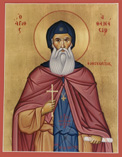 Born in 1310, he lived in asceticism on the Holy Mountain.
He founded a famous monastery in the Meteora in Thessaly. He had great gifts of discernment
and wonder-working. |
Author’s note: Philaret also mentions Gabriel the Child-martyr in his ‘Lives of the Saints’. He was born in the village of Zvjerka, near the town of Zabludov and was only six years old when, in 1648, on the day when his parents were not at home, he was lured to a lonely place by a Jew named Schutko and crucified there. His body was found incorrupt thirty years later.
FOR CONSIDERATION
St. Anastasios of Mount Sinai teaches: ‘God gives to each Christian an angel to care for him through his whole life, unless he drives him away by his evil doings. But, as smoke drives away bees and an evil stench doves, so the guardian of our life, our angel, is driven away from us by our sins: drunkenness, debauchery, anger and the rest. An angel guides every faithful man in every good work, while the demons exert all their strength to disturb the faithful and deprive them of the heavenly kingdom.’ That angels are close to men and take care of them is testified to in the whole of holy Scripture and especially in the New Testament. Besides this, there are in the Orthodox Church innumerable testimonies of holy men and women who witnessed to that which Anastasios emphasises: that a gracious and powerful messenger of God, a soldier of the King of heaven, an angel of light, accompanies each one of us through this life. Who, other than the insane, would drive away such a good friend from himself? Indeed, only the insane and other ignoramuses drive away their greatest friends, their guardian angels.
Daily Scripture Readings taken from The Orthodox New Testament, translated and published by Holy Apostles Convent, Buena Vista, Colorado, copyright © 2000, used with permission, all rights reserved.
Daily Prologue Readings taken from The Prologue of Ochrid, by Bishop Nikolai Velimirovic, translated by Mother Maria, published by Lazarica Press, Birmingham, England, copyright © 1985, all rights reserved. Edited by Dormition Skete.