

Daily Devotional
Monday, April 25, 2016 (NS), April 12, 2016 (OS)
Fast Day. No Meat, Fish, Dairy, Eggs, Alcohol or Olive Oil Allowed.
Holy Week
| Holy and Great Monday |
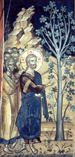
The commemoration of our holy father among the saints, Basil the Confessor, Bishop of Parium.
Scripture Readings
Paschalion — Movable Calendar
Holy and Great Monday
Epistle
There is no Epistle Reading this day because of Holy Week.
Gospel
In the Orthros
The Reading is from the Holy Gospel according to Saint Matthew [§ 84]. At that time:
21 18As Jesus returned into the city, He hungered. 19And having seen a single fig tree in the way, He came to it and found nothing on it, except leaves only, and said to it, “Let there be no more fruit from thee forever.” And forthwith the tree was withered. 20And after the disciples saw it, they wondered, saying, “How was the fig tree withered forthwith?” 21And Jesus answered and said to them, “Verily I say to you, if ye have faith and doubt not, ye shall not only do that which was done to the fig tree, but even if ye should say to this mountain, ‘Be thou taken away, and be thou cast into the sea,’ it shall come to pass. 22“And all things, whatsoever ye ask in prayer, believing, ye shall receive.”
23And after He came into the temple, the chief priests and the elders of the people came to Him as He taught, saying, “By what authority doest Thou these things? And who gave Thee this authority?” 24And Jesus answered and said to them, “I also will question you for one word, which if ye tell Me, I also will tell you by what authority I am doing these things. 25“The baptism of John—from what place was it? From heaven or from men?” And they were reasoning with themselves, saying, “If we should say, ‘From heaven,’ He will say to us, ‘Why then did ye not believe him?’ 26“But if we should say, ‘From men,’ we fear the multitude; for all hold John as a prophet.” 27And they answered and said to Jesus, “We know not.” And He said to them, “Neither do I tell you by what authority I am doing these things. 28“But what think ye? A certain man had two children, and he came to the first and said, ‘Child, go today and work in my vineyard.’ 29“And he answered and said, ‘I will not’; but afterward he felt regret and went forth. 30“And he came to the second and spoke in like manner. And he answered and said, ‘I go, sir’; and he went not forth. 31“Which of the two did the will of the father?” They say to Him, “The first.” Jesus saith to them, “Verily I say to you that the tax collectors and the harlots go into the kingdom of God before you. 32“For John came to you in the way of righteousness, and ye believed him not; but the tax collectors and the harlots believed him; and ye, having seen, felt no regret afterward in order to believe him.
33“Hear another parable: There was a certain man, a master of a house, who planted a vineyard, and put a hedge around it, and dug a wine-vat in it in which to press grapes, and built a tower. And he let it out to vinedressers, and went abroad. 34“And when the season of the fruits drew near, he sent forth his slaves to the vinedressers to receive his fruits. 35“And the vinedressers took his slaves, and indeed beat one, and killed another, and stoned another. 36“Again he sent forth other slaves, more than the first; and they did to them in like manner. 37“But afterwards he sent his son to them, saying, ‘They will respect my son.’ 38“But after the vinedressers saw the son, they said among themselves, ‘This is the heir. Come, let us kill him, and let us gain possession of his inheritance.’ 39“And they took him, and cast him out of the vineyard, and slew him. 40“Whenever the lord, therefore, of the vineyard should come, what shall he do to those vinedressers?” 41They say to Him, “He will evilly destroy those evil men, and will let out the vineyard to other vinedressers who shall render to him the fruits in their seasons.” 42Jesus saith to them, “Did ye never read in the Scriptures, ‘The stone which the builders rejected, this became the head of the corner; this came to be from the Lord, and it is marvellous in our eyes [Ps. 117(118):22, 23; cf. Is. 28:16]’? 43“On this account I say to you that the kingdom of God shall be taken away from you, and it shall be given to a nation producing the fruits of it.”
In the Liturgy of the Presanctified Gifts
The Reading is from the Holy Gospel according to Saint Matthew [§ 98]. At that time:
24 3As Jesus sat upon the Mount of Olives, His disciples came to Him privately, saying, “Tell us, when shall these things be, and what shall be the sign of Thy coming, and of the completion of the age?” 4And Jesus answered and said to them, “Be taking heed, lest anyone lead you astray. 5“For many shall come in My name, saying, ‘I am the Christ’; and they shall lead astray many. 6“But ye are going to hear of wars and rumors of wars; keep on looking out and cease being clamorous; for all these things must come to pass, but the end is not yet. 7“For nation shall be stirred up against nation, and kingdom against kingdom. And there shall be famines, and plagues, and earthquakes, in place after place. 8“But all these are a beginning of birth pangs. 9“Then they shall deliver you up to affliction, and shall kill you; and ye shall be hated by all the nations for My name’s sake. 10“And then many shall be made to stumble, and shall deliver up one another, and shall hate one another. 11“And many false prophets shall be raised up, and shall lead astray many. 12“And because lawlessness shall have been multiplied, the love of the multitude shall grow cold. 13“But the one who endureth to the end, this one shall be saved. 14“And this Gospel of the kingdom shall be proclaimed in all the inhabited world, for a testimony to all the nations; and then shall the end come. 15“Whenever ye therefore see ‘the abomination of the desolation [cf. Dan. 9:27, 12:11],’ which was spoken of by Daniel the prophet, standing in the holy place”—the one who readeth, let him understand— 16“then let those in Judæa flee to the mountains. 17“The one on the housetop, let him not come down to take away anything out of his house. 18“And the one in the field, let him not return back to take up his clothes. 19“And woe to those who are with child and to those who give suck in those days. 20“But be praying that your flight might not take place in winter, neither on a sabbath. 21“For then there shall be great affliction, such as hath not been from the beginning of the world until the present, no, nor ever shall be. 22“And if those days were not shortened, no flesh would be saved; but for the elect’s sake those days shall be shortened. 23“Then if anyone should say to you, ‘Behold, here is the Christ,’ or ‘Here,’ do not begin to believe it. 24“For false christs and false prophets shall be raised up, and they shall produce great signs and wonders, so as to lead astray, if possible, even the elect. 25“Behold, I have told you beforehand. 26“If then they should say to you, ‘Behold, He is in the desert,’ do not begin to go forth; ‘Behold, He is in the secret chambers,’ do not begin to believe it. 27“For even as the lightning cometh forth from the east and appeareth as far as the west, so also shall be the coming of the Son of Man. 28“For wheresoever the corpse may be, there will the eagles be gathered together.
29“And straightway after the affliction of those days shall the sun be darkened, and the moon shall not give her light, and the stars shall fall from the heaven, and the powers of the heavens shall be shaken. 30“And then shall the sign of the Son of Man appear in the heaven, and then the tribes of the earth shall mourn, and they shall see the Son of Man coming on the clouds of the heaven with power and great glory. 31“And He shall send forth His angels with a great sound of a trumpet, and they shall gather together His elect from the four winds, from the uttermost parts of the heavens unto their extremities. 32“Now learn the parable from the fig tree: Whenever its branch at once should become tender and put forth leaves, ye know that the summer is near. 33“Thus also ye, whenever ye see all these things, know ye that it is near, even at the doors. 34“Verily I say to you, in no wise shall this generation pass away until all these things shall have taken place. 35“The heaven and the earth shall pass away, but My words in no wise shall pass away.”
Menaion — Fixed Calendar
The commemoration of our holy father among the saints, Basil the Confessor, Bishop of Parium.
No readings given.
Lives of the Saints (Prologue)
April 25th – Civil Calendar
April 12th – Church Calendar
1. Our Holy Father Isaac II of Syria (St. Isaac the Syrian is commemorated on Jan. 28th).
St. Gregory the Dialogist writes about this Isaac. He went to Italy in the time of the Goths and went into the church in the town of Spoleto to pray. He asked the verger to leave him locked in the church all night, and thus spent the night in prayer without moving from that place. He spent the next day and night in the same way. The verger called him a hypocrite and struck him a blow—and lost his reason at that same moment. Seeing how the verger was so fiercely tormented, Isaac bent over him and the evil spirit fled from him, leaving him whole. People came to hear of this happening, and the whole town thronged around this wonderful elder. They offered him money and goods, but he refused them all and would accept nothing. Instead, he withdrew to a forest, where he built himself a cell, which quickly became transformed into a large monastery. Isaac became famous for his miracles, especially for his discernment. One evening he told the brethren to take all the hoes out to the vineyard and leave them there. The next day, the brethren set out for the vineyard, taking their lunch, as they had no workers. When they got there, they found as many people working as there were hoes to work with. It transpired that these people had come as thieves to steal the hoes, but by the power of God, they were constrained to work all night.
On another occasion, a couple of almost-naked men came seeking clothing from Isaac. He sent a monk to a hollow tree at the end of the road, to bring what he found there. The monk went off, found some clothing and brought it back to the monastery. The abbot took the clothing and gave it to the beggars. They were profoundly ashamed as they recognized their own clothing, which they had concealed in that tree.
A man once sent two beehives to the monastery. A monk hid one of them on the way, and brought the other to the abbot. The saint said to him: ‘Be careful when you go back to that beehive you hid on the way. It’s been taken over by poisonous snakes. Take care they don’t bite you!’
St. Isaac reposed in peace in 550.
2. St. Basil the Confessor.
In a time of iconoclasm, this virtuous man was bishop in the city of Parius in Asia Minor. He refused to sign the imperial order against the veneration of icons, for which he was greatly persecuted and tortured. But he remained firm as diamond in his Orthodoxy. He died in the first half of the 8th century, and went to the Lord.
3. Our Holy Father Akakios.
From the village of Gollitsa in Epirus, he was a great Athonite ascetic, spiritual guide and clairvoyant, and had many heavenly visions. He gave his blessing to several monks to seek martyrdom. He entered into rest at the age of 98, in 1730.
4. Our Holy Mother Athanasia.
Born on the island of Aegina of rich and eminent parents, she gave her goods to the poor and went off to a monastery, where she heaped greater and greater asceticism on herself. She took food only once a day, and that only bread and water, and in the Great Fast only once every two days. Only at Nativity and Pascha did she taste fish and oil. Although she was abbess of the monastery, she was the servant of all the other sisters and was ashamed that any should wait on her. She was made worthy of the great gift of wonder-working, both during her lifetime and after her death. She entered into rest in the Lord in 860.
FOR CONSIDERATION
The wicked Emperor Constantine Kopronymos had a virtuous daughter, the maiden Anthusa, ‘a beauteous branch of an evil stem’. She remained set against all her father’s urgings that she marry, for she was firmly bound in whole-hearted love to Christ the Lord. When her father died, Anthusa gave her goods away to the poor and became a nun in a monastery. It is a cause of wonder that many men of gentle birth have left the vanity of the world and set off on the narrow way after Christ; and it is twice as great a cause of wonder that women scorn youth and wealth and all the transient attraction of the world for the love of Christ. The Lord Himself said that it is hard for a rich man to enter the kingdom of heaven. Hard, yes: but not impossible. To those who scorn their own selves, it is easy to scorn riches and the whole world.
Daily Scripture Readings taken from The Orthodox New Testament, translated and published by Holy Apostles Convent, Buena Vista, Colorado, copyright © 2000, used with permission, all rights reserved.
Daily Prologue Readings taken from The Prologue of Ochrid, by Bishop Nikolai Velimirovic, translated by Mother Maria, published by Lazarica Press, Birmingham, England, copyright © 1985, all rights reserved. Edited by Dormition Skete.