

Daily Devotional
Tuesday, April 14, 2026 (NS), April 1, 2026 (OS)
No Fasting.
Bright Week - No Fasting All Week
Tuesday of the Renewal Week
The commemoration of our holy Mother Mary of Egypt.
Scripture Readings
Paschalion — Movable Calendar
Tuesday of the Renewal Week
Epistle
The Reading is from the Acts of the Apostles [§ 4]. In those days:
2 14Peter, having taken his stand with the eleven, lifted up his voice and spoke out to them, “Men, Jews, and all those who inhabit Jerusalem, let this be known to you, and hearken to my words. 15“For these are not drunk, as ye suppose, for it is the third hour of the day. 16“But this is that which hath been spoken by the Prophet Joel, 17“‘And it shall be in the last days,’ saith God, ‘I will pour out of My Spirit upon all flesh; and your sons and your daughters shall prophesy, and your young men shall see visions, and your old men shall dream dreams [cf. Joel 2:28]; 18“‘and even upon My bondmen and upon My bondwomen in those days I will pour out of My Spirit [cf. Joel 2:29],’ and they shall prophesy. 19“‘And I will show wonders in the heaven above, and signs on the earth below, blood and fire and vapor of smoke [cf. Joel 2:30]. 20“‘The sun shall be turned into darkness, and the moon into blood, before that great and notable day of the Lord come [Joel 2:31]. 21“‘And it shall be that everyone, whosoever shall call upon the name of the Lord, shall be saved [Joel 2:32].’”
Gospel
The Reading is from the Holy Gospel according to Saint Luke [§ 113]. At that time:
24 12Peter arose and ran to the sepulcher; and having stooped to look, he saw the linen cloths lying alone, and departed to his home, wondering at that which had come to pass.
13And behold, two of them were going on the same day to a village, being sixty stadia from Jerusalem, which is named Emmaus. 14And they were conversing with one another about all these things which had taken place. 15And it came to pass, while they conversed and discussed, Jesus Himself drew near and was going together with them. 16But their eyes were held, so as not to recognize Him. 17And He said to them, “What words are these which ye exchange with one another, as ye walk and are sad in countenance?” 18And the one whose name was Cleopas answered and said to Him, “Art Thou sojourning alone as a stranger in Jerusalem, and hast not known the things which came to pass in it in these days?” 19And He said to them, “What kind of things?” And they said to Him, “The things concerning Jesus the Nazaræan, Who was a man, a prophet, mighty in deed and word before God and all the people, 20“how both the chief priests and our rulers delivered Him up to a judgment of death, and crucified Him. 21“But we were hoping that He was the One Who was about to redeem Israel; but, beside all these things, this passeth as the third day today since these things took place. 22“Yea, and certain women from among us astonished us, who were early at the sepulcher. 23“And not having found His body, they came, declaring also to have seen a vision of angels who say, ‘He is living.’ 24“And certain of those with us went away to the sepulcher, and found it thus, even as also the women said; but Him they did not see.” 25And He said to them, “O ye without understanding and slow in heart to believe in all things which the prophets spoke! 26“It was needful for the Christ to have suffered these things and to have entered into His glory, was it not?” 27And beginning from Moses and from all of the prophets, He went on interpreting to them in all the Scriptures the things concerning Himself. 28And they drew near to the village where they were going; and He was making as if to be going further. 29And they constrained Him, saying, “Stay with us, for it is toward evening, and the day hath waned.” And He went in to stay with them. 30And it came to pass, as He reclined at table with them, He took bread, and blessed it, and broke it, and was giving it to them. 31And their eyes were opened, and they recognized Him; and He disappeared from them. 32And they said to one another, “Our heart was burning in us as He was speaking to us in the way and as He was opening to us the Scriptures, was it not?” 33And they rose up the same hour and returned to Jerusalem, and found the eleven gathered together, and those with them, 34saying, “The Lord was raised indeed, and appeared to Simon.” 35And they began relating those things that occurred in the way, and how He was known to them in the breaking of the bread.
Menaion — Fixed Calendar
The commemoration of our holy Mother Mary of Egypt.
Epistle
The Reading is from the Epistle of Saint Paul to the Galatians [§§ 208, 209]. Brethren:
3 23Before faith came, we were being guarded under the law, having been closed up to the faith about to be revealed. 24Therefore the law hath become our tutor until Christ, in order that we might be justified by faith. 25But faith having come, we are no longer under a tutor. 26For all are sons of God through faith in Christ Jesus. 27For as many as were baptized into Christ, ye put on Christ. 28There is neither Jew nor Greek, there is neither slave nor free, there is neither male and female; for ye are all one in Christ Jesus. 29And if ye are Christ’s, then are ye Abraham’s seed, and heirs according to promise.
4 1Now I say, as long as the heir is an infant, he differeth nothing from a slave, though he is lord of all; 2but he is under guardians and stewards until the appointed time of the father. 3So we also, when we were infants, were enslaved under the elements of the world. 4But when the fullness of the time came, God sent forth His Son, born of a woman, born under the law, 5in order that He might redeem those under the law, that we might receive what is our due, the adoption as sons.
Gospel
The Reading is from the Holy Gospel according to Saint John [§ 28]. At that time:
8 3The scribes and the Pharisees brought to Jesus a woman who had been caught in adultery. And after they made her stand in the midst, 4they say to Him, “Teacher, this woman was caught committing adultery, in the very act. 5“Now Moses, in the law, commanded us to stone such women. Thou therefore, what sayest Thou?” 6But this they were saying, putting Him to the test, in order that they may have an accusation against Him. But Jesus, having stooped down, was writing with His finger on the ground. 7And as they continued questioning Him, He lifted up Himself and said to them, “The one who is without sin among you, let him first cast the stone at her.” 8And again He stooped down and was writing on the ground. 9But after they heard and were convicted by their own conscience, they were going out one by one, beginning from the eldest. And Jesus was left alone, and the woman being in the midst. 10And after Jesus lifted up Himself, He said to her, “Woman, where are those accusers of thine? Did no one condemn thee?” 11And she said, “No one, Sir.” And Jesus said, “Neither do I condemn thee; go, and henceforth no longer go on sinning.”
Lives of the Saints (Prologue)
Paschalion — Movable Calendar
Saints Raphael, Nicholas and Irene
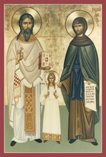 Archimandrite Raphael,
Abbot of the Theotokos Monastery, and Hierodeacon Nicholas, settled on Lesvos (Mytilene) after
the Fall of the City. In 1463, Muslims attacked on Great Friday. Archimandrite Raphael was pulled
and tugged by his hair and beard along the rock-strewn ground. He was struck with clubs, spears,
lances, and swords, while his hands were tied behind his back. He was stabbed all over and cast
down paralyzed. His tongue was severed, and he was then suspended upside down from a large walnut
tree, repeatedly beaten and whipped for 24 hours. He was cut down from the tree and stripped of
his clothing from the waist up. After being positioned on his knees, five savage Muslims took up
a saw and began cutting away his lower jaw. Nearly unconscious, he had his head placed on a
square icon, where they struck him thrice on his mouth, extracting his lower jaw, thus separating
his head from his body on Bright Tuesday, then the 9th of April.
Archimandrite Raphael,
Abbot of the Theotokos Monastery, and Hierodeacon Nicholas, settled on Lesvos (Mytilene) after
the Fall of the City. In 1463, Muslims attacked on Great Friday. Archimandrite Raphael was pulled
and tugged by his hair and beard along the rock-strewn ground. He was struck with clubs, spears,
lances, and swords, while his hands were tied behind his back. He was stabbed all over and cast
down paralyzed. His tongue was severed, and he was then suspended upside down from a large walnut
tree, repeatedly beaten and whipped for 24 hours. He was cut down from the tree and stripped of
his clothing from the waist up. After being positioned on his knees, five savage Muslims took up
a saw and began cutting away his lower jaw. Nearly unconscious, he had his head placed on a
square icon, where they struck him thrice on his mouth, extracting his lower jaw, thus separating
his head from his body on Bright Tuesday, then the 9th of April.
Deacon Nicholas, bound to a smaller walnut tree, witnessed these
terrifying scenes. He, too, was stabbed, but he did not die immediately. It was only after his
terror-stricken tender heart had borne the startling sight of his wounds and the punishments of
the others, that he suffered cardiac arrest.
Twelve-year-old Irene was seized and had boiling water poured into
her mouth. One of her delicate hands was severed, the limb being tossed before the parents. The
stump of her arm was bleeding profusely, as they chopped away one of her little feet. The lass
was then pushed down into an earthen jar, where she was burned alive after being doused with
flammable liquids and torching her bodice. As she stood trapped in the flaming cask, she lifted
up her eyes heavenward and called upon Christ, commending her soul into the hands of the Lord.
In 1959 and in the early 1960’s miraculous visions of the
martyrs were granted to the islanders. The recovery of their relics has been the occasion of
countless miracles and pilgrimages.
Menaion — Fixed Calendar
April 14th – Civil Calendar
April 1st – Church Calendar
1. St. Mary of Egypt.
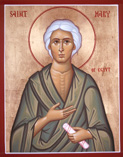 The recorder of the life of this wonderful saint was St. Sophronios,
Patriarch of Jerusalem. A hieromonk, the elder Zosimas, had gone off at one time during the Great
Fast a twenty-days’ walk into the wilderness across the Jordan. He suddenly caught sight of
a human being with a withered and naked body and with hair as white as snow, who fled in its
nakedness from Zosimas’ sight. The elder ran a long way, until this figure stopped at a
stream and called: ‘Father Zosimas, forgive me for the Lord’s sake. I cannot turn
round to you, for I am a naked woman.’ Then Zosimas threw her his outer cloak, and she
wrapped herself in it and turned round to him. The elder was amazed at hearing his name from the
lips of this unknown woman. After considerable pressure on his part, she told him her life-story.
She had been born in Egypt, and from the age of twelve had lived a life enjoying the pleasures of
the flesh whenever she could, spending seventeen years in this way of life in Alexandria. Urged
by the lustful fire of the flesh, she one day got into a ship that was sailing for Jerusalem.
Arriving at the holy city, she made to go into the church to venerate the Precious Cross during
the Elevation of the Holy Cross, but some unseen power prevented her from entering. In great
fear, she turned to an icon of the Mother of God that was in the entrance, and begged her to let
her go in and venerate the Cross, confessing her sin and impurity and promising that she would
then go wherever the Panagia led her. She was then allowed to enter the church. After venerating
the Cross, she went out again to the entrance, and standing in front of the icon, thanked the
Mother of God. Then she heard a voice: ‘If you cross the Jordan, you will find true
peace.’ She immediately bought three loaves of bread and set off for the Jordan, arriving
there the same evening. She received Communion the following morning in the monastery of St.
John, and then crossed the river. She spent forty-eight whole years in the wilderness in the
greatest torments, in terror, in struggles with passionate thoughts like gigantic beasts. She fed
only on herbs and what could be found in the desert. After that, when she was standing in prayer,
Zosimas saw her lifted up in the air. She begged him to bring her Communion the next year on the
bank of the Jordan, and she would come to receive it. The following year, Zosimas came with the
Holy Gifts to the bank of the Jordan in the evening, and stood in amazement as he saw her cross
the river. He saw her coming in the moonlight, and arriving on the further bank, make the sign of
the Cross over the river. She then walked across it as though it were dry land. When she had
received Communion, she begged him to come again the following year to the same place where they
had first met. Zosimas went, and found her dead body there on that spot. Above her head in the
sand was written: ‘Abba Zosimas, bury in this place the body of the humble Mary. Give dust
to dust. I passed away on April 1st, on the very night of Christ’s Passion, after having
partaken of the divine Mysteries.’ Zosimas learned her name for the first time, and also
the awe inspiring marvel that she had arrived at that stream the previous year on the night of
the same day on which she had received Communion—a place that he had taken twenty days to reach.
And thus Zosimas buried the body of the wonderful saint, Mary of Egypt. When he returned to the
monastery, he recounted the whole story of her life and the wonders to which he had been an
eyewitness. Thus the Lord glorifies repentant sinners. St. Mary is also commemorated in the Fifth
Week of the Great Fast. The Church holds her up before the faithful in these days of the Fast as
a model of repentance. She entered into rest in 522.
The recorder of the life of this wonderful saint was St. Sophronios,
Patriarch of Jerusalem. A hieromonk, the elder Zosimas, had gone off at one time during the Great
Fast a twenty-days’ walk into the wilderness across the Jordan. He suddenly caught sight of
a human being with a withered and naked body and with hair as white as snow, who fled in its
nakedness from Zosimas’ sight. The elder ran a long way, until this figure stopped at a
stream and called: ‘Father Zosimas, forgive me for the Lord’s sake. I cannot turn
round to you, for I am a naked woman.’ Then Zosimas threw her his outer cloak, and she
wrapped herself in it and turned round to him. The elder was amazed at hearing his name from the
lips of this unknown woman. After considerable pressure on his part, she told him her life-story.
She had been born in Egypt, and from the age of twelve had lived a life enjoying the pleasures of
the flesh whenever she could, spending seventeen years in this way of life in Alexandria. Urged
by the lustful fire of the flesh, she one day got into a ship that was sailing for Jerusalem.
Arriving at the holy city, she made to go into the church to venerate the Precious Cross during
the Elevation of the Holy Cross, but some unseen power prevented her from entering. In great
fear, she turned to an icon of the Mother of God that was in the entrance, and begged her to let
her go in and venerate the Cross, confessing her sin and impurity and promising that she would
then go wherever the Panagia led her. She was then allowed to enter the church. After venerating
the Cross, she went out again to the entrance, and standing in front of the icon, thanked the
Mother of God. Then she heard a voice: ‘If you cross the Jordan, you will find true
peace.’ She immediately bought three loaves of bread and set off for the Jordan, arriving
there the same evening. She received Communion the following morning in the monastery of St.
John, and then crossed the river. She spent forty-eight whole years in the wilderness in the
greatest torments, in terror, in struggles with passionate thoughts like gigantic beasts. She fed
only on herbs and what could be found in the desert. After that, when she was standing in prayer,
Zosimas saw her lifted up in the air. She begged him to bring her Communion the next year on the
bank of the Jordan, and she would come to receive it. The following year, Zosimas came with the
Holy Gifts to the bank of the Jordan in the evening, and stood in amazement as he saw her cross
the river. He saw her coming in the moonlight, and arriving on the further bank, make the sign of
the Cross over the river. She then walked across it as though it were dry land. When she had
received Communion, she begged him to come again the following year to the same place where they
had first met. Zosimas went, and found her dead body there on that spot. Above her head in the
sand was written: ‘Abba Zosimas, bury in this place the body of the humble Mary. Give dust
to dust. I passed away on April 1st, on the very night of Christ’s Passion, after having
partaken of the divine Mysteries.’ Zosimas learned her name for the first time, and also
the awe inspiring marvel that she had arrived at that stream the previous year on the night of
the same day on which she had received Communion—a place that he had taken twenty days to reach.
And thus Zosimas buried the body of the wonderful saint, Mary of Egypt. When he returned to the
monastery, he recounted the whole story of her life and the wonders to which he had been an
eyewitness. Thus the Lord glorifies repentant sinners. St. Mary is also commemorated in the Fifth
Week of the Great Fast. The Church holds her up before the faithful in these days of the Fast as
a model of repentance. She entered into rest in 522.
2. Our Holy Father Procopius the Czech.
Born in Hotish, Czechoslovakia, of eminent parents, he became a priest and went off into the mountains to live after the example of the Eastern hermits. Herzog Ulrich came across him by chance and helped him to found the monastery of St. John the Forerunner by the River Sazava. This holy man entered into rest in 1053.
FOR CONSIDERATION
Why is so much said and written about the sufferings of holy men and women? Because these saints are counted as victors—and how can there be victory without struggle, pain and suffering? In ordinary, earthly warfare no man is reckoned as victorious and heroic who has never been in battle, who has not endured and suffered to a very considerable extent. All the more is this so in spiritual warfare, where the truth is clear and where self-assertion is not only of no use but is a real hindrance. He who knows no struggle for the sake of Christ, either with the world or with the devil or with his own self—how can he be counted among Christ’s soldiers? How, indeed, among Christ’s fellow-victors? St. Mary spoke of this gigantic struggle to the elder Zosimas: ‘For the first seventeen years in this wilderness, I struggled with my mindless passions as with fierce beasts. I wanted to eat meat and fish, which I had eaten abundantly in Egypt. I wanted to drink wine, and did not even have water here. I wanted to hear lustful songs. And I wept and smote my breast. I prayed to the most pure Mother of God to remove these thoughts from me. When I had wept and smote my breast for a long time, I then saw a light that flooded over me from all sides, and was filled with a wonderful peace.’
Daily Scripture Readings taken from The Orthodox New Testament, translated and published by Holy Apostles Convent, Buena Vista, Colorado, copyright © 2000, used with permission, all rights reserved.
Daily Prologue Readings taken from The Prologue of Ochrid, by Bishop Nikolai Velimirovic, translated by Mother Maria, published by Lazarica Press, Birmingham, England, copyright © 1985, all rights reserved. Edited by Dormition Skete.